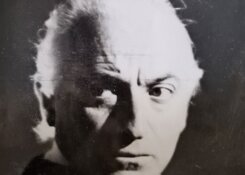
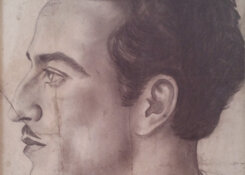
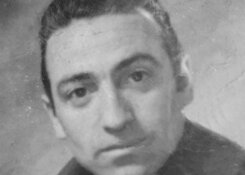
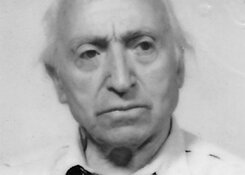
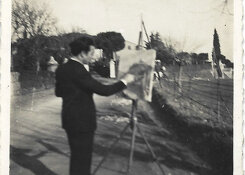
For information and contact details for Aristide Gattavecchia, sculptor and painter, visit the website or write directly to:
www.gattavecchia.it
email : aristide@gattavecchia.it
Sculptor and Painter
Italian artist of the 1900s
Sculptor and Painter
Italian artist of the 1900s
" Art is freedom and communicative power" A. Gattavecchia



.png "artboxy)")
Aristide Gattavecchia: Origins, Formation, and Experimentation
Aristide Gattavecchia was born in Cesena in 1907.
His intellectual and personal development took shape within a historical context profoundly marked by the conflicts of the twentieth century.
The experience of the two world wars left a lasting imprint on his sensibility, directing his attention from an early age toward the major themes of existence, suffering, and the fragility of the human condition.
From youth onward, he displayed a deep interest in art and history, disciplines that would remain central to his cultural outlook and to the expressive path he later pursued.
It was only in the postwar years that Gattavecchia was able to devote himself fully and consistently to artistic practice, embarking on an independent and multifaceted journey in both painting and sculpture.
His work was marked by a notable openness to experimentation, both technically and materially. Alongside canvas and paper, he explored a range of supports, including wood panel and plastic; in sculpture, he worked with such varied materials as clay, plaster, and polystyrene.
This diversity of media was not simply an expression of formal variety, but rather the result of a deliberate search for the most effective means of giving visual form to intense inner experience.
Aristide Gattavecchia: The art of Existence
Gattavecchia’s work is distinguished by its sustained engagement with the problematic nature of existence.
His oeuvre addresses some of the defining concerns of modern life: the violence of war, the breakdown of communication, solitude, the transformation of contemporary society, and the contradictions produced by consumer culture.
These themes are accompanied by reflections on broader civil and cultural issues, including ecology, the responsible use of resources, the mechanisms of exclusion, and the many forms of discrimination.
In this sense, his art may be understood as a mode of critical inquiry into the present, one capable of uniting ethical awareness with powerful expressive force.
A Profound Inquiry into the Human Condition
At the heart of Gattavecchia’s work lies a sustained exploration of the human condition, pursued through images that reject descriptive excess in favour of an essential, often starkly dramatic vision of figure and space.
His works frequently present isolated bodies, at times distorted or stripped of precise physiognomic features, suspended within rarefied environments devoid of stable points of reference.
Such choices create a field of acute existential tension, in which the human figure appears marked by a radical failure of communication and by a profound sense of estrangement.
Stylistically, Gattavecchia developed a language of striking expressive energy.
In his painting, colour assumes both psychological and symbolic weight: intense reds evoke states of alarm, fear, and inner turmoil, while dense, structuring blacks define the contours of bodies and objects with force, heightening their dramatic intensity.
His experience as a sculptor also had a profound impact on his painting, which often reveals a strong plastic sensibility and a distinctly volumetric construction of form.
His attention to relief, weight, and the tension of matter lends his paintings a density that exceeds purely chromatic effect and brings them, in expressive power, close to the sculptural realm.
Existentialism and Surrealism in Gattavecchia’s Work
Gattavecchia’s cultural horizon lies at the intersection of existentialism, expressionism, and surrealist suggestion.
His work does not merely seek to render the visible world; rather, it attempts to penetrate the darker, deeper regions of individual experience, investigating the human being through inner motives and through a troubled relationship with reality.
In many works, figures seem to emerge from suspended, mental, and allusive spaces, where reality is transformed into vision and objective appearance gives way to images of intense symbolic charge.
Aristide Gattavecchia: Style and Influences
According to the critical interpretation offered by Professor Vittorio Sgarbi, Gattavecchia’s work may be aligned with an expressionist tendency that, in its emotional intensity and in the distortion of form, recalls the example of Edvard Munch, particularly in works such as La Bruna, Pensieri, and Leda.
In other works, including Frammentazione, Intrusioni, and Composizione, a more overtly surrealist component becomes apparent, with disturbing forms and ambiguous presences surfacing from the image and evoking the world of dreams and the unconscious.
At the same time, his work also includes passages close to abstraction, as in Frammenti and Trasfigurazioni, where form and colour free themselves from figurative representation in order to become direct vehicles for inner states, tensions, and ideas.
An Artist in Dialogue with Twentieth-Century Movements
Aristide Gattavecchia’s artistic trajectory thus reflects a personal and coherent engagement with several of the major movements of the twentieth century.
While moving across different formal directions, the artist preserved an independent and unmistakable voice, grounded in a constant expressive urgency and in a profound commitment to the themes of the human condition.
His work stands out for its poetic coherence and density of content, and may be regarded as a relatively independent yet significant contribution to the wider landscape of modern and contemporary art.
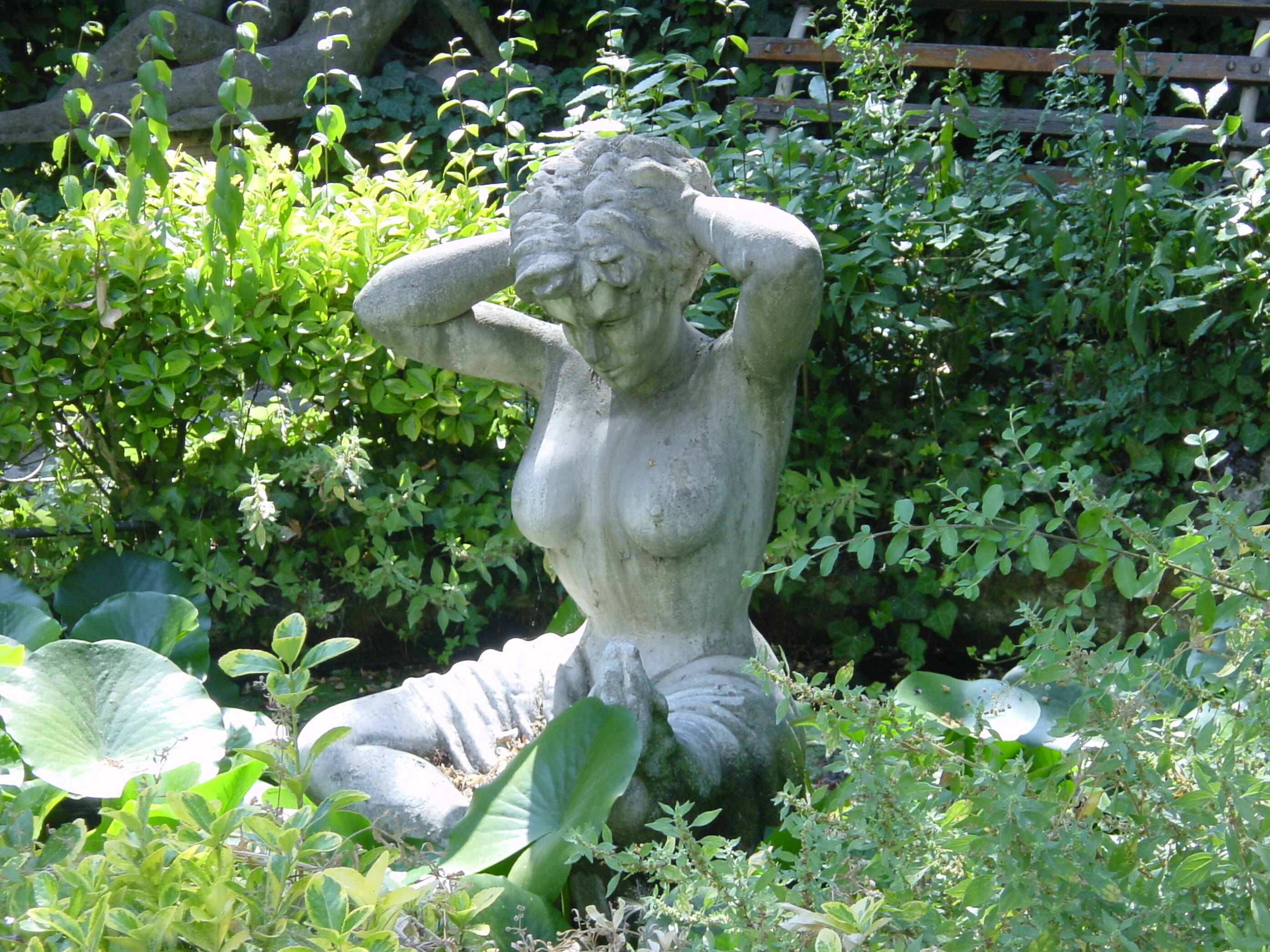
Sculpture by Aristide Gattavecchia “The Nymph” 1958